About the Author
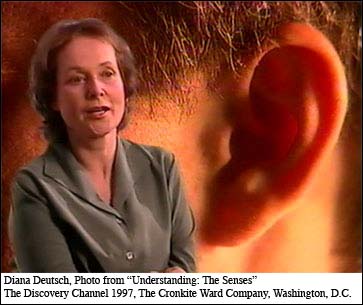
Diana Deutsch is Professor of Psychology at the University of California, San Diego, and conducts research on perception and memory for sounds, particularly music. She has discovered a number of musical illusions and paradoxes, which include the octave illusion, the scale illusion, the glissando illusion, the tritone paradox, the cambiata illusion, the phantom words illusion and the speech-to-song illusion, among others. She also explores ways in which we hold musical information in memory, and in which we relate the sounds of music and speech to each other. Much of her current research focuses on the question of absolute pitch - why some people possess it, and why it is so rare. (See, for example, recent work comparing the prevalence of absolute pitch in speakers of tone language and non-tone language).
Deutsch obtained a First Class Honors B.A. in Psychology, Philosophy and Physiology from Oxford University, and a Ph.D. in Psychology from the University of California, San Diego. She has over 150 written publications, including books, book chapters, and articles. She is Editor of the book The Psychology of Music, Academic Press, 1982, 2nd Edition 1999, (see review), 3rd Edition 2013, (see review), and author of the compact discs Musical Illusions and Paradoxes (1995) and Phantom Words and Other Curiosities (2003) see review of both CDs.
Deutsch has been elected a Fellow of the American Association for the Advancement of Science, the Acoustical Society of America, the Audio Engineering Society, the Society of Experimental Psychologists, the American Psychological Society, and the American Psychological Association. She has served as Governor of the Audio Engineering Society, as Chair of the Section on Psychology of the American Association for the Advancement of Science, as President of Division 10 of the American Psychological Association (Society for the Psychology of Aesthetics, Creativity and the Arts), and as Chair of the Society of Experimental Psychologists. She is Founding Editor of the journal Music Perception, and served as Founding President of the Society for Music Perception and Cognition. She was awarded the Rudolf Arnheim Award for Outstanding Achievement in Psychology and the Arts by the American Psychological Association in 2004, the Gustav Theodor Fechner Award for Outstanding Contributions to Empirical Aesthetics by the International Association of Empirical Aesthetics in 2008, and the Science Writing Award for Professionals in Acoustics by the Acoustical Society of America in 2011.
Some media descriptions of research by Deutsch and colleagues
-
Capítulo 2: Diana Deutsch, la musa de las ilusiones - RTVE.es, July, 2021
WHAT IS THE TRITONE PARADOX? (ILLUSTRATED GUIDE W/ AUDIO EXAMPLES) - NOAH TEACHEY, Producer Hive, June, 2021
Why Does Music Make Us Feel Things? - Daniel Kolitz, Gizmodo, March, 2021
Musical Illusions and Phantom Words: How Music and Speech Unlock Mysteries of the Brain. By Diana Deutsch. New York: Oxford University Press, 2019, xviii + 243 pages - Daniel Shanahan, Music Theory Spectrum, March, 2021
Solveigs Speisa Musikk - Are Brean - Om musikk og hjernen (podcast), February, 2021
Ilusiones auditivas creadas a partir de los Tonos de Shepard y su aplicación artística - Esteban Peris Aviñó, Sul Ponticello, February, 2021
Shepardtöne - Biologie Seite, January, 2021
Es ist nicht das, wonach es sich anhört - Stephan Beuting, Deutschlandfunk Nova, February, 2020
Episode 3: Cognitive Psychology and Music, Episode 4: Ambiguity, Paradox and Musical Illusion
- J Milo Raylor, We're All Bats, Listening Arts Channel, Decemember, 2020
La musique et le langage - Silvia Bencivelli, Futura Santé, December, 2020
Can Music Probe Mentality? (pt 2)
- Closer to Truth, December, 2020
Can Music Probe Mentality?
- Closer to Truth, December, 2020
How Do Brains Make Music? - Closer to Truth, December, 2020
Repetition Sells? Why Catchy Songs Get Stuck in Our Heads - Medium.com, December, 2019
Book Review: Tales of the expected - Jason Warren, Brain, 142(11), September, 2019, 3655-3659
Can you believe your ears? - Trevor Cox, BBC Radio 4, August, 2019
Auditory Illusions - BBC Radio 4, August, 2019
Shepardtöne
- , October, 2019
Falling Trees
- Ideas Roadshow's IBDP Portal, June, 2019
#68 | Sonic Illusions
- Twenty Thousand Hertz, June, 2019
S3, Episode 9: The Illusionist (Jun. 8, 2019) - Hi-Phi Nation, June, 2019
Seminal research into musical illusions influences new piece for Contemporary Music Festival - Toby Leigh, University of Plymouth News, January, 2019
Das absolutes Gehor: Musikalisch den richtigen Ton treffen - BR.de, February, 2019
Why repeating words sound like music to your brain - The Verge, June, 2018
If You Think the Woman in This Clip Is Singing, You've Let Your Brain Fool You - Melanie Aman, Woman's World, June, 2018
Ghosts in the Machine - BBC Radio 4, October, 2018
AAAS Volunteers Spark Interest in the Science Behind Our Five Senses - Andrea Korte, AAAS, April, 2018
When Does Speech Become Music? - BBC World Service, April, 2018
The speech to song illusion - BBC World Service, June, 2018
Sounds sometimes behave so strangely.
- Interview with Georgia Mills, Naked Scientists, BBC and ABC, April, 2018
Episode 10: Sometimes Behave So Strangely Redux - Cadence Podcast, October, 2017
Perfect Pitch - Radio Health Journal, June, 2017
Music is not for ears - Aeon, November, 2017
Do Musicians Make Better Language Learners? - Psychology Today, July, 2017
Os três pequenos Mozart da rua Esperança - Brasil El País, November, 2017
El oído absoluto y las lenguas tonales - Cátedra de Cultura Científica, July, 2017
2017 : What Scientific Term or Concept Ought to be More Widely Known?
- Diana Deutsch, Edge, April, 2017
Giỏi âm nhạc nhờ học tiếng Việt - Trung? (Vietnamese are Good at Learning Music) - Cat Tuong, Theo Gia đình/Telegraph Nguồn: http://sinhcon.com Vui lòng không xóa link nguồn!, December, 2016
Domestic Science, with Matt Parker, Steve Mould and Helen Arney. Episode 1 - BBC Radio 4, July, 2016
Prince im Sommer der Legenden auf radioeins, Interview with Knut Elstermann - Rundfunk Berlin-Brandenburg (rbb), August, 2016
Musikalisch den richtigen Ton treffen - BR.de, January, 2016
AAAS Volunteers Present "Science of the Senses" at USA Science & Engineering Festival - Andrea Korte, AAAS, May, 2016
How the orchestra is arranged by the biology of the brain - Richard Kunert, Aeon, April, 2016
3 ảo giác âm thanh chắc chắn bạn chưa bao giờ được biết (3 audio hallucinations you never knew) - THEO TRÍ THỨC TRẺ, KENH 14, April, 2016
Wenn Der Sound Trägt - Audioversum, January, 2016
Das absolute Gehör wohnt in China - NDR Kultur, January, 2016
Stefan Kleins Wissenschaftsgespräche - Copyright Stefan Klein 2015, Die Zeit Magazin (Germany), January, 2016
Diana Deutsch, compiled by David Pothier and Carolyn Falls - David Pothier and Carolyn Falls, ENT & Audiology News, 24, Issue e, July, 2015
The strangest sounds in the world - David Robson, BBC, April, 2015
SYLLABLE VARIATIONS (2015) - Sarah Rara and Luke Fischbeck, The Enemy, Vol II. No. II, 2015
The Stealthy Sounds of Cocktail Parties - 3 Quarks Daily, October, 2015
What is Perfect Pitch Anyway? - Michael Levine, SoundtracksAndTrailerMusic.com, November, 2015
Listen To The Tritone Paradox, An Auditory Illusion - Curiosity, December, 2015
#LDOnda: ¿Por qué gusta la canción del verano? - Naukas, October, 2015
Reworked version of Mariah Carey's All I Want for Christmas Is You tricks the brain into hearing her voice - Kashmira Gander, The Independent, December, 2015
How trippy version of Mariah Carey Christmas hit fools the brain
- Aviva Rutkin, New Scientist, December, 2015
Discover the auditory illusion that makes Tchaikovsky’s sixth symphony sound so good - Matthew Parsons, CBC Music, April, 2015
15-28 Segment 1: Perfect Pitch - Reed Pence, Radio Health Journal, July, 2015
These Sounds Will Confuse Your Brain - Alex Kasprak, BuzzFeed, September, 2015
Vuoi scoprire quanto il tuo cervello è lateralizzato? Fallo con l’illusione dell’ottava - cittadelmonte.it, September, 2015
Scientific Discovery: Rare Whistling Language Offers Researchers Unique Insight Into Communication
- International Business Times, August, 2015
The Power of the Human Voice - BBC World Service, July, 2015
E se quello che sentiamo non fosse reale? - Linkiesta, May, 2015
Dillo un'altra volta (ovvero perché la ripetizione in musica è così importante)
- Rockit.it, April, 2015
Hearing Is Our Least Trustworthy Sense - Orion Jones, Big Think, April, 2015
Sumérgete en el extraño mundo de las ilusiones auditivas - David Robson, BBC Mundo, May, 2015
¿PUEDEN CREERLE A SUS OÍDOS? ESTÁS ILUSIONES AUDITIVAS TE DEMOSTRARAN QUE NO - Sopitas, April, 2015
The strangest sounds in the world
- David Robson, BBC Future, April, 2015
Diana Deutsch: Jak nasze emocje, doświadczenia i myśli wpływają na odbiór muzyki? - Katarzyna Paluch, Tygodnik Powszechny (Poland), March, 2015
The Elastic Brain - Rebecca Boyle, Aeon, February, 2015
Thủ thuật "đánh lừa não bộ" bằng hiệu ứng âm thanh - , March, 2014
Believing Your Ears: Probing the Brain through Musical Illusion: A conversation with Diana Deutsch
- Ideas Roadshow, September, 2014
Can You Trust Your Ears? (Audio Illusions) - Asap Science, May, 2014
Some Science Behind Singing - Matt Bilyard, Bang! The Oxford Scientist Magazine (UK), November, 2014
¿Es el tono perfecto cuestión de genética? - Health Day, October, 2014
Rovarszárnyak éneke - Bacsadi Zsófia, Magyar Narancs, October, 2014
Ovale Fenster: Ein Hirnwettlauf im Allerhorbarsten
- RTV Radio (Serbia), October, 2014
The Song of Insect Wings
- Zsofia Bacsadi, Magyar Narancs (Hungary), October, 2014
The Human Zoo, Interview with Michael Blastand - BBC Radio 4, July, 2014
These Auditory Illusions Are Absolutely Bewildering - Robert T. Gonzalez, io9, May, 2014
Language and Tone - Susan Scutti , Medical Daily, January, 2014
Audio Illusions Prove Your Hearing May Not Be As Good As You Thought - Janissa Delzo, Medical Daily, June, 2014
The science of audio illusions, or fooling people's ears - Esther Inglis-Arkell, io9, February, 2014
Play it again, Sam! Pourquoi nous voulons chaque fois entendre - Arnaud Lefebvre, Express (France), March, 2014
One more time: Why do we listen to our favourite music over and over again? Because repeated sounds work magic in our brains - Elizabeth Hellmuth Margulis, Aeon, March, 2014
How often does speech turn into song? - Esther Inglis-Arkell, io9, March, 2014
Localisation auditive: confusions et illusions - Enclopedia Universalis France, 2013
Auditory Illusions: A Tour of Tricky Sounds - Jose Drost-Lopez, Psych Talk, January, 2013
Hallucinations auditives - France Culture (France), April, 2013
Entretien avec Diana Deutsch chercheur - Radio France (France), April, 2013
The psychology of a second listen - Charlie McCarron, Minnesota Public Radio, November, 2013
Hinh - Von Marianne Wendt und Christian Schiller, Deutschlandradio, December, 2013
Creative voices come to Cleveland
- The Cleveland Stater, June, 2013
Absoluut Gehoor: Lust of last
- Hieke van Hoogdalem, Akkoord Magazine (Netherlands), July, 2013
BBC Radio 4 documentary "Out of the Ordinary |Rorschach Audio - Art & Illusion for Sound" - Jolyon Jenkins, BBC Radio 4, March , 2013
BBC Archive on Four on Radiolab - Judith Kampfner, BBC Radio 4, April , 2013
Musical illusions-Radiolab - Brenna Farrell, Radiolab, May, 2013
The Sounds of a Mystery
- Corinna da Fonseca-Wollheim, The New York Times, April, 2013
Review of The Psychology of Music, Third Edition
- Classical Net, February, 2013
El sentido de la musica - Eduardo Punset, Redes 271 (Barcelona, Spain), April, 2012
New Study Ties Perfect Pitch to Genetics
- Choral Director, October, 2012
Dr. Diana Deutsch, University of California, San Diego - Genetics of Perfect Pitch
- Bradley Cornelius, Academic Minute, WAMC, Northeast Public Radio, November, 2012
Sorry, music lessons can't teach perfect pitch - Meghan Holohan, The Body Odd, NBC News, October, 2012
Is Perfect Pitch Genetic? - MedlinePlus, October, 2012
Perfect Pitch: Knowing the Note may be in your Genes - Science Daily, October, 2012
Perfect pitch: Knowing the note may be in your genes - e! Science News, October, 2012
Can't sing in key? It may be that no amount of music lessons can help: Perfect pitch is 'all in the genes' - Daily Mail (UK), October, 2012
Perfect Pitch Mystery: Research Shows The Note May Be In Your Genes
- Huffington Post, October, 2012
Perfect pitch may be genetic: study - Yahoo! News, October, 2012
Is Perfect Pitch Genetic?
- U.S. Dept. of Health and Human Services, Office of Minority Health, October, 2012
Perfect pitch may be genetic - Health24, October, 2012
El "tono perfecto" puede venir en los genes
- Yahoo! Noticias, October, 2012
Les illusions auditives
- AgoraVox, April, 2012
Sang och musik i svenskundervisningen - Maria Kapla and Johannes Stahlberg, Svenska institutet, April, 2012
Interruptions #4, Bregman/Deutsch Chimaera
- Florian Hecker, RWM Radio Web Macba, February, 2012
Musicality of Speech: Spoken Melody - Hearing Voices (National Public Radio)., February, 2012
Ovale Fenster
- Radioplay, Southwest German Radio, March, 2012
Tala i toner - Spraktidningen, December, 2011
Between Speech and Song
- Temma Ehrenfeld, APS Observer, 24, December, 2011
Episode 25 - Two words. sounds like. auditory illusions - Dr. Andi Horvath, Museum Victoria podcast, October, 2010
Auditory Illusions
- Nicholson, Christie, Scientific American Podcast, April, 2010
The Music of Language [Audio Slideshow] - Wickelgren, Ingrid, Scientific American, July/August, 2010
More than words - David Rothenberg, The Guardian (UK), May, 2009
Freaky news about your brain may change your mind - Elizabeth Landau, CNN Health, August, 2009
Words into a song: the illusion of the brain? (in Chinese) - Chinese Academy of Audiology, May, 2009
The Ears Have It - Charlotte Gardner, BBC Magazine, July, 2009, 37-39
Az abszolút hallásról - Hir6, January, 2009
Toontaal sleutel tot absoluut gehoor - Erica Renckens, NEMO Kennislink (The Netherlands), May, 2009
Perfect Pitch Related to Language - Steve Mirsky, Scientific American, May, 2009
Tone language is key to perfect pitch - e! Science News, May, 2009
Absolutes Gehör: Kein genetischer Glücksfall, sondern sprachabhängig - Der Standard (Austria), May, 2009
Forscher lüften Geheimnis des absoluten Gehörs - Sybille Möckl, Die Welt Online (Germany), May, 2009
Das absolute Gehör - Werner Siefer, Focus Online (Germany), May, 2009
Perfect Pitch: Language Wins Out Over Genetics - PhysOrg, May, 2009
Tone Language Is Key To Perfect Pitch - Inga Kiderra, Science Daily, May, 2009
Tonal languages are the key to perfect pitch - Hazel Muir, New Scientist, April, 2009
Toned Up, Tuned In - Rachel Saslow, The Washington Post, May, 2009
Learning Chinese languages makes you musical, claim scientists - Richard Alleyne, Telegraph (UK), April, 2009
Perfect Pitch: Language Wins Out Over Genetics - Diana Deutsch, Kevin Dooley, Trevor Henthorn and Brian Head, Media Release, Acoustical Society of America, May, 2009
Talk into tune - Carl Wilson, Globe and Mail, February, 2009
Brain researchers track auditory illusions - Jochen Paulus, Southwest German Public Radio (Germany), December, 2008
Music special: Five great auditory illusions - Michael Marshall, New Scientist, February, 2008
The Speech-to-Song Illusion - Diana Deutsch, Rachael Lapidis, and Trevor Henthorn, Media Release, Acoustical Society of America, November, 2008
Brain sees fine line between speech and song - New Scientist, November, 2008
Our Brains Need Inhibitors to Perceive Speech - Softpedia, November, 2008
Wiederholungen machen Sprachmelodie horbar' - Scienceticker.info, November, 2008
Wie uns das Ohr ubers Ohr haut - Interview with Frank von Groteluschen, German Public Radio (Germany), October, 2008
Absolutt gehør ved hjelp av språk? - Harald Aastorp, Forskning.no (Norway), February, 2008
Wenn einmal der Wurm drin ist - Von Eva-Maria Schnurr, Die Zeit Magazin (Germany), April, 2007
Relativismo LingüÃstico: ¿Qué tal Suena? - Javier Valenzuela, Ciencia Cognitiva, December, 2007
'A perfect pitch match.' - Excerpted from, Oliver Sacks' book: Musicophilia: Tales of Music and the Brain. Columbia Magazine, 2007
¿Cómo percibimos la música? Los Lectores Preguntan a Eduardo Punset - Eduardo Punset, 2007
Through to the next round - Marcus Low, Health24, 2007
Musical Language (Radiolab), Podcast - WNYC's Radiolab, 2007
¿Se encuentra el oído absoluto en los genes? - Ed Edelson trans Dr. Tango, Yahoo Salud, August, 2007
'Is Perfect Pitch All in the Genes?' - Ed Edelson, HealthDay News, August, 2007
'Psychologists Create Surprising Musical Illusion' - Adriana Salerno, Voice of America, August, 2007
"Musical Illusions" - Julie J. Rehmeyer, Science News, June, 2007
Speaking in Tones. Ni hao or bonjour: do genes drive preference for language type? - Choi, Charles Q., Scientific American, September, 2007
'Behaves So Strangely'
- Interview with Jad Abumrad, New York Public Radio, April, 2006
'Musical Language' - Interview with Jad Abumrad, New York Public Radio, April, 2006
'Do My Ears Deceive Me' - Interview with Chris Maslanka, BBC Radio 3, April, 2006
'Your Brain on Music' - David Ranada, Sound & Vision Magazine, May, 2006
'Music on the Mind' - Scott Fields, APS Observer, April, 2006
'Prelude to Perfect Pitch' - Kate McCartin, Trenton Times, May, 2006
'Perfect pitch' - Fran Kelly, ABC Radio National, January, 2005
'Is It Possible To Achieve Perfect Pitch?' - Dean Edell, ABC7 KGO-TV/DT, February, 2005
'L'oreille absolue des asiatiques' - Bruno Rougier, Radio France, January, 2005
'Pitch Perfect' - Sadie F. Dingfelder, APA Monitor on Psychology, February, 2005
'Perfect pitch' - James Shreeve, National Geographic, March, 2005
'Oreille absolue : avantage aux Chinois' - Pour La Science, January, 2005
Musical Mandarins - 21st Century Online, December, 2004
Ernest Ruiz and Fernando Cabedo Bosquet - Mundo hi-fi, December, 2004
'Science in Action' - Interview with Molly Bentley, BBC World Service, December, 2004
'The World Today' - Interview with BBC World Service, November, 2004
'Warum Mandarin das absolute Gehör begünstigt' - Eva Hörschgen, Wissenschaft.de, November, 2004
'Chinesen sind die besseren Musiker' - Katharina Kramer, Die Welt (Germany), December, 2004
'Absolutes Gehor: Sprache schult das Ohr' - Spiegel Online (Germany), November, 2004
'L'oreille absolue : plus facile pour les Chinois' - Isabelle Masingue, Quebec Science, November, 2004
Wieso haben so vielo Chinesen das absolute Gehör? - Katherina Kramer, NZZ am Sontag (Switzerland), November, 2004
'Mandarin Chinese speaks volumes in giving the young an ear for music' - Ian Sample and Faisal al Yafai, The Guardian (UK), November, 2004
'Tonsprachen und absolutes Gehor gehoren zusammen.' - Yahoo! Nachrichten, November, 2004
'Study: Language Determines Music Skills' - Jennifer Viegas, Discovery Channel, November, 2004
'Psychologists Pobe Perfect Pitch' - Nadja Geipert, ScienceNow, American Association for the Advancement of Science, November, 2004
'Speaking Tonal Languages Promotes Perfect Pitch' - Don Monroe, Scientific American, November, 2004
'Tone language translates to perfect pitch' - Inga Kiderra, Science Daily, November, 2004
'Perfect Pitch in Tone Language Speakers Carries Over to Music' - Diana Deutsch, Trevor Henthorn, Elizabeth Marvin, and HongShuai Xu, Media Release, Acoustical Society of America, November, 2004
'Can't get it out of my head' - Carl Zimmer, The Sunday Telegraph Magazine, February, 2004
'The illusions range from the beguilingly simple to, as she says, "true weirdness, the twilight zone."' - Peter Monaghan, 'In the Twilight Zone of Sound', Notes from Academe, Chronicle of Higher Education, November, 2003
Das absolute Gehör ist gewöhnlicher als gedacht - Ulrich Dewald, Wissenschaft.de, April, 2003
'Potential for Acquiring Absolute Pitch Based on Time and Genetics' - Brian Weaver, American Psychological Society, December, 2002
The Science Behind the Song Stuck in Your Head - Roy Rivenburg, Los Angeles Times, October, 2001
'A paradox of musical pitch' - Deborah Smith, Monitor on Psychology, American Psychological Association, 2001
'The Biology of Perfect Pitch: Name That Tone' - Michael Abrams, Discover, December, 2001
'Auditory Illusion Shaped by First Language' - Charles Seife, ScienceNow, American Association for the Advancement of Science, December, 2000
Anyone can have perfect pitch, all they have to do is learn Vietnamese at a very early age - Cherry Norton, The Independent, November, 1999
'Study links perfect pitch to tonal language' - James Glanz, New York Times (front page), November, 1999
'Striking the right Note' - Kathryn Brown, The New Scientist, December, 1999
'UCSD prof makes a hard pitch for perfect pitch' - David Graham, San Diego Union Tribune, December, 1999
'Speaking in Tones' - Alan Hall, Scientific American, November, 1999
Tone Language Speakers Possess Absolute Pitch - Diana Deutsch, Trevor Henthorn, and Mark Dolson, Media Release, Acoustical Society of America, 1999
Understanding the Senses - The Cronkite Ward Company, Washington D.C., The Discovery Channel, 1997
'Do you hear what I hear?' - Steven Hunt, Discovery Channel, Canada, March, 1997
'You must be hearing things' - Bob McDonald, Quirks and Quarks, Canadian Broadcasting Corporation (Canada), 1997
'Musical Illusions and Paradoxes' - Robyn Williams, The Science Show, Australian Broadcasting Corporation, 1997
'"Musical Illusions and Paradoxes" will let you experience some striking sonic chicanery.' - Shawn Carlson, Scientific American, The Amateur Scientist, December, 1996
Mothers and their children hear a musical illusion in strikingly similar ways - media release, Acoustical Society of America, 1996
'Escher for the Ear' - Philip Yam, Scientific American, March, 1996
What is Music? - NOVA, 1989
What bloggers are saying-
Speech-to-Song Illusion and a High-Tech Use for Tree Rings - Curiosity Daily Podcast, July, 2021
Do you hear what I hear? - Teufel, February, 2021
The Tritone paradox (try it with a group of musicians) - Joe Bennett, January, 2021
DIABOLUS IN MUSICA, TUTTA LA VERITÀ SUL TRITONO MALEDETTO! - blog di metal, cultura e tanto rumore, October, 2019
Dr. Diana Deutsch Across Science and Art - Michael Gordon, Journey2Psychology, July, 2019
Hearing also has an illusion? ! How are you attracted by pop music? - Yahoo Taiwan, August, 2019
Sometimes behaves so strangely - MetaFilter, September, 2019
Musical Language - Making Machines, October, 2019
The Speech-to-Song Illusion - Futility Closet, October, 2019
Diana Deutsch - Revolvy, 2019
Hacking Perfect Pitch - Martha Langdon, Maker Bolder, May, 2019
Deutsch’s scale illusion - Revolvy, 2018
Beyond Yanny or Laurel: 6 Other Aural Illusions and How They Work - Mark Mancini, Mental Floss, May, 2018
Musical illusions - Philip Ball, Homunculus, October, 2018
Sound illusions #1158 Sept 2016 - Justin Kitch, Daily Curio, September, 2016
The Chromatic Illusion - Futility Closet, Podcast Episode 110:, June, 2016
Nicht Gene, sondern frühkindlicher Einfluss entscheidend für das in China viel häufigere absolute Gehör - Helmut Schatz, Medizinische Kurznachrichten der Deutschen Gesellschaft für Endokrinologie, June, 2016
Diana Deutsch, la musica y el language - Almudena M. Castr, Enchufa2, February, 2016
It’s all in your head - Sound show, Apple Podcast, December, 2016
Are Chinese Speakers More Likely to Have Perfect Pitch? - Joe Milazzo, TutorMing Mandarin Learning Tips Blog, December, 2016
Yeah, I got perfect pitch. - Telecaster Discussion Page Reissue, December, 2016
Psychoacoustics and Auditory Illusion Introduction - Kat Nine Music, July, 2016
Nicht Gene, sondern frühkindlicher Einfluss entscheidend für das in China viel häufigere absolute Gehör - Helmut Schatz, Medizinische Kurznachrichten der Deutschen Gesellschaft für Endokrinologie, June, 2016
Weird Audio Illusions
- Every Things, April, 2016
The Chromatic Illusion - Greg Ross, Futility Closet, June, 2016
Sängerinnen und Sänger musizieren mit mehr Gefühl als Instrumentalisten - Jenny-Fox, February, 2016
Music That Sometimes Behaves So Strangely - Mariana, February, 2016
Ears wide shut – it’s eerie - Gibberish, February, 2016
Harmonic function of speech - KVR Audio, March, 2016
Mysterious Melody - Meara O'Reilly, February, 2016
Ilusiones Auditivas: Cómo Engañar a Tu Cerebro - PsicoWisdom, January, 2016
Are music and speech closely related? - Talk Classical, March, 2015
That Magic Sound - Dynamix Productions, January, 2015
Speech to song illusion - Enchufa2, October, 2015
The Ghost of Mariah Carey - Psychology Wizard, December, 2015
Absolutes Gehör - Im neuen Blog begrüßt Sie Jan Reichow, December, 2015
Ilusiones auditivas: La paradoja del tritono - Neoteo, December, 2015
EL SENTIDO DE LA MÚSICA - El Lenguaje Musical de Fátima, December, 2015
Oft wiederholte Sätze klingen wie Gesang
- Christoph Bördlein, April, 2015
The Tritone Paradox -Â An Audio Illusion? - The Gear Page, April, 2015
Can Speaking a Language Give You a Musical Advantage? - SiOWfa15: Science in Our World: Certainty and Controversy, September, 2015
This audio illusion has everyone disagreeing. People hear anything from rainbow to mango. What do you hear?
- Twitter, April, 2015
De Spraak-Muziekillusie: Maak Muziek in je Hoofd! - Donders Wonders, April, 2015
Sometimes, Sound Can Behave So Strangely
- Greg L. Lowhorn, Exploring the Issues of Life, February, 2015
Beauty in Repetition: Listen to Hanno Leichtmann's Minimal Studies - Peter Kirn, February, 2015
What is the name of the phenomenon in which upon hearing same sound repeatedly, one begins to hear a rhythm? - Stack Exchange, February, 2015
Using Brain Wave Data to Convert a Seizure to Song - Brian Foo, DATA-DRIVEN DJ, February, 2015
Ouvido Absoluto - Quinta Essentia, January, 2014
But They Sometimes Behave So Strangely - Inverse Square Trio, 2014
Hacking Perfect Pitch - Garth Sundem, Maker Boulder, September, 2014
Really weird acoustic illusion behind all symphony music
- Ali Cook, May, 2014
Auditory Illusion 3: Phantom Words (Youtube video with comments) - Alan Key, July, 2014
OÃdo Absoluto
- Paloma Valeva, 2014
Tire o fone de ouvido para se exercitar com mais seguranca
- Est em dom Pedrito, August, 2014
A pill for tones / musical illusions - Chinese-forums, January, 2014
Tritone Paradox, Ilusi Suara Yang Membingungkan - Erick thevirkills , April, 2014
This fascinating auditory illusion transforms normal speech into music - The Coli, March, 2014
Música x Criança - Thelo Campos, March, 2014
Diana Deutsch's Phantom Words - Pascal Wallisch, Google+, February, 2014
Música y repetición, una ilusión auditiva
- Fogonazos Asombros diarios, March, 2014
Ouvido Absoluto - Gustavo de Francisco, flautadocebr.quintaessentia.com.br, January, 2014
Phantom Words - BBC Future, 2013
.they sometimes behave so strangely. sometimes behave so strangely. sometimes behave so strangely. sometimes behave so strangely. - Twitter, April, 2013
The Isengard Effect, or, Musical Language - Blarg, June, 2013
Vom Zauber der Sprachmelodie - Jan Reichow, June, 2013
La musique, le cerveau et nous - Sirtin science, December, 2013
The Tritone Paradox - The way these specially constructed tones are perceived changes from person to person - Reddit, August, 2013
TIL. Talking is really just singing - Reddit, May, 2013
"Sometimes Behaves So Strangely" - Nathan McKee, serctvnewsroomsite, April, 2013
More than you may want to know about absolute pitch
- Lois Svard, The musician's brain, September, 2013
Absolutes Gehor - Medizinportal, October, 2013
SOMETIMES BEHAVE SO STRANGELY - Mark Ty Wharton, likebeing.com, 2013
Sound effects fun - University of Southampton, 2013
Your Voice is Music to our Ears - Elizabeth Holmes, VoiceOverXtra, April, 2013
I heard a clip from this the other night on the BBC. - Applied Linguistics Discussion Group, July, 2013
Sometimes Behaves SO Strangely - Sax on the Web Forum, June, 2013
Start 'Em Young: Two Studies on the Mystery of Perfect Pitch - Operagasm, May, 2013
Speech to Song Illusion - Wordcraft, May, 2013
Perfect Pitch: Acquired or Inherited? - Karen McCarthy, Postcognitive Topics, March, 2013
The Biological Basis of Orchestra Seating - Richard Kunert, Brain's Idea, May , 2013
Stanford's Music & Brain Symposium explores "Inner Voices" - Dana Wen, I care if you listen|Washington Composers Forum, April , 2013
Musical Illusions with Dr. Diana Deutsch
- Charlie McCarron, Composer Quest, April, 2013
Examples of Illusion
- Your Dictionary Examples, 2013
Muzik yalan soyler mi? - Emre Akoz, Sabah, March, 2013
Sonic Tour of the Brain
- Guerilla Science, March, 2013
HV132-Musicality of Speech: Spoken Melody
- Barry Golding, Hearing Voices from NPR, February, 2012
Les Illusions Auditives - PaperBlog, April, 2012
Language and Musical Ability - Helen Sol, L2 Listening, September, 2012
Sound and our Minds - Kaja Weeks , Early Childhood Music & Movement Association, December, 2012
Musicality in Mandarin - Ryan's Journal, Nov, 2012
Ouvido absolute - um dom de genio - Grupo de Opera Canto Dell'arte, October, 2012
Les illusions auditives - Strange stuff and funky things, April, 2012
No, really, teach your toddler perfect pitch
- Wired, February, 2012
Going Beyond Hermann von Helmholtz: The Octave Illusion with Respect to Handedness - Tania Gooden, History of German Science, April, 2011
Diana Deutsch - Noi theo thanh dieu - Chiec non, Sept, 2011
Tonal languages and perfect pitch
- Confused Laowai, April, 2011
Do you have perfect pitch or relative pitch? - Eddie Jobson Forum, November, 2011
Sometimes behaves so strangely
- Inaccurate Interpretations, January, 2011
Tien gekke geluidsillusies - Frederik Meuris, ZDNET Belgie, 2011
Did music originate as a behavioral adaptation? - Music 0000001, Aug-Sept, 2010, 335-337
Bizarre auditory illusion: a spoken phrase repeated 10 times out of context appears to be *sung* when heard in a sentence.
- Reddit, August, 2010
Perfect pitch - a connection between language and music
- Studio3Music, 2010
Musica e Psicologia: "Chi ascolta musica comunica meglio?"
- PsicologiaNeuroLinguistica, November, 2010
Tritone Paradox, Ilusi Suara Yang Membingungkan (in Indonesian)
- Vahn Saryu, October, 2010
half note juke (after diana deutsch) - MeFi Music, April, 2010
Linguistically vented tonality - Wong, Kee Zhang, Metaharmonist, September, 2010
WorldWeird: Loops
- WHITECHAPEL Discussions, January-October, 2009
Cambiata illusion
- Nestor, James, GET HIGH NOW (without drugs), 07, 2009
Chromatic illusion - Nestor, James, GET HIGH NOW (without drugs), 07, 2009
Salviaesque Auditory Illusion - Entheogen Dot, July, 2009
Top 10 según alguien - EDOZE GAUZA, October, 2009
Absolutes Gehor - You got it? - Simon Born, September, 2009
On Having Really Pretty Good (If Not Perfect) Pitch - Brian Rowland, June, 2009
sometimes behave so strangely. - Pnosis, March, 2009
Comments on: "Scientists say learning Chinese languages makes you musical" - Digg, May, 2009
Find Out If You're Tone Deaf; Plus, Are Asians Naturally Better Musicians? - William Weir, Hartford Courant, May, 2009
Speech to Song: An Audio Illusion - The Open End, April, 2009
Sprechen oder Singen? - Bessersprechen.de, February, 2009
Pitchy Talk - The Orb of Whammy, May, 2009
Speech-to-Song Illusion - Zoilus, February, 2009
Comments on: Fool Your Ears - Five Great Auditory Illusions - Digg, June, 2008
A l'illusson - Le blog musical de Ponski et Hekojin, December, 2008
'Put your headphones on' - MetaFilter, February, 2008
'Top 10 Incredible Sound Illusions' - The List Universe, February, 2008
Speaking becomes Singing - Vai.com, November, 2008
But they sometimes behave so strangely
- Dr. Beren, LiVEJOURNAL, October, 2007
Audio illusions that will fool your ear (and brain) - EE|Times, November, 2007
Sing Me an E, Any E - Curt Lindsay, Can't See the Forest, March, 2007
Absolute Pitch - Staffan A. Svensson, October, 2006
'Sometimes behave so strangely' - Auditory Archives, December week 2, 2006
'Music and language' - Discover - Cosmic Variance, 2006
'Sometimes behaves so strangely' - Crooked Timber, 2006
Deutsch's Musical Illusions
- electro-music.com, November, 2003
Ouvido absoluto - Um dom de genio
- Super Interessante, May, 2000
I just learned about the delightful speech-to-song illusion - MARK FRAUENFELDER, boingboing
Tool #3.1: Octave Displacement Follow-Up Post
- Composers Toolbox
Quotes about the CDs-
'A wonderful source of audio examples to explore and experiment with.' - CafeMuse
'each demonstration provides the amateur scientist with the materials to conduct research on how the brain processes sound.' - The Society for Amateur Scientists
'On the musical illusions CD you'll find the octave illusion and the tritone paradox, both of which are discussed in the textbook. On the Phantom Words CD you'll find additional clever demonstrations, including phantom words and 'music' emerging from repetitive speech.' - Matlin & Foley, Sensation and Perception
'An amazing collection of auditory illusions very reasonably priced. Well worth buying for school resources, if not home use. Also has a very useful explanatory booklet.' - The National Science and Technology Centre, Canberra, Australia.
'These two CDs are absolutely mind-boggling. Diana is, in effect, hosting a magical mystery tour of your own brain, and believe me, it's quite a ride. - Ian Rowland, Mentalist Magician, Entertainer, and Skeptic
What Are Musical Paradox and Illusion? - Ben Carson, American Journal of Psychology, Spring, 2007
'Of course being audiophiles, we love to experiment - with nearly everything. And here's just the ticket: a foray into the perception and memory for sound, with extensive examples, albums, and a decidely scientific and professional bent that should enchant you for some time' - Barry Ober, Boston Audio Society, November, 2005
'One of the weirdest experiences one can have. Don't miss it.' - Skeptics Society
'It's like a magic show' - Psychology Today, Psychology Today, February, 2004
'I could scarcely believe my ears.' - Eugene Pitts, The Audiophile Voice, Vol 10, 2004, 1
'you'll know just how tenuous the connection is between speech and song' (listen to entire show online) - Jad Abumrad, WNYC Radio, November, 2003
'A fascinating new exploration into how we can be fooled - Scot Morris, Science Writer, Omni Magazine
'Ready for a science experiment on the stereo? Musical Illusions and Paradoxes . an audio CD created by psychologist Diana Deutsch at the University of California at San Diego, proves that illusions aren't just for the visual realm . They are great for amazing your friends' - Discover, December, 1998
'A fascinating compact disc . Musical Illusions and Paradoxes is both entertaining and disconcerting. I was amazed by my own misperceptions and . left somewhat disturbed wondering if throughout my life I have been hearing what Verdi and Britten intended' - Patrick Bell, Sound and Video Contractor, March, 1996
|
Customers from 49 countries
have purchased the CDs from this website:
|